swiss medicaXXI century S.A.
A cup that suddenly feels harder to hold, repeated tripping on one foot, or speech that becomes less clear can be easy to dismiss at first. Yet when these changes persist and gradually worsen, they may be early signs of ALS. These symptoms can also have many other causes, so no single sign is enough to confirm the diagnosis.
Terminology note: In the United States, ALS is also commonly known as Lou Gehrig’s disease, named after the American baseball player who was diagnosed with the condition. Therefore, references to the early manifestations of ALS in this article also refer to the early symptoms of Lou Gehrig’s disease. For consistency, we mostly use the abbreviation “ALS” throughout.
What Are the Early Signs and Symptoms of ALS?
Before delving into the specific manifestations, the table below outlines what patients frequently observe initially:
| Area affected first | Very early ALS symptoms: what a person may notice |
| Hand or arm | Dropping things, poor grip, difficulty with buttons or keys |
| Leg or foot | Tripping, foot drop, trouble going upstairs |
| Muscles of speech | Unclear, slow, nasal, or slurred speech |
| Swallowing muscles | Choking, coughing when drinking, difficulty handling saliva |
| Muscles overall | Twitching, cramps, stiffness, or visible wasting; |
However, persistent, progressive muscle weakness is usually more characteristic of the condition than any isolated twitch, cramp, or brief moment of clumsiness.
Progressive Muscle Weakness That Does Not Go Away: One of the First Signs of ALS
One of the first signs may be that a familiar movement no longer comes as easily as before. You may notice that one hand does not grip as firmly, one leg feels less reliable, or a simple everyday task requires more concentration and effort.
Unlike ordinary tiredness after exercise, amyotrophic lateral sclerosis early symptoms tend to persist, gradually worsen, and begin to interfere with specific activities rather than improve with rest.
Hand Weakness and Loss of Fine Motor Control
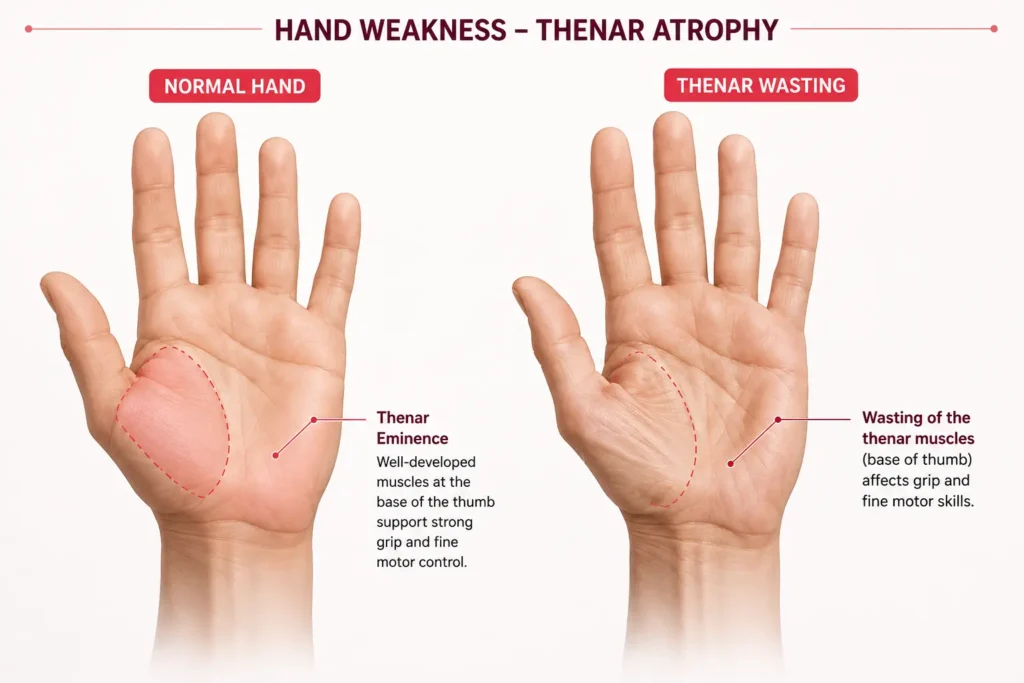
Hand weakness may initially feel more like unusual clumsiness than an obvious loss of strength. You may start dropping a cup, struggle to fasten buttons, find it harder to turn a key, or notice that your handwriting has become less controlled.
Foot Drop, Tripping, and Changes in Walking
In ALS, changes in walking may begin with the feeling that one foot is not lifting properly. As the muscles that raise the front of the foot weaken, the toes may drag with each step, causing you to catch them on rugs, stumble on level ground, or feel less stable on stairs. Early symptoms often affect only one side, making one leg feel less dependable than the other.
Muscle Twitching, Cramps, and Stiffness
Muscle twitches can feel alarming, especially for someone already worried about the first signs of ALS. However, twitching alone is common and may occur because of stress, fatigue, exercise, or caffeine. This is more clinically significant when symptoms begin with twitching and are associated with persistent weakness, visible muscle wasting, or increasing difficulty using the same part of the body. Some people may also notice frequent cramps or a growing sense of stiffness in their muscles.
Slurred Speech or Changes in the Voice
Speech changes often develop gradually. Words may become less distinct, your speech may slow down, or your voice may sound more nasal. As the muscles involved in speaking become weaker, family members or friends may have more difficulty understanding you, and you may find yourself repeating what you have said.
Difficulty Chewing, Swallowing, or Managing Saliva
A person may cough when drinking water, need more time to chew and swallow, or feel that food does not move as smoothly as before. Liquids may be especially difficult to manage. Saliva may also become harder to swallow—not because the body necessarily produces more of it, but because weakened tongue and throat muscles cannot move it as effectively. These symptoms warrant prompt medical assessment because swallowing problems can increase the risk of choking, aspiration, dehydration, and inadequate nutrition.
Why Early ALS Symptoms Can Look Different from Person to Person
ALS does not begin in the same way for everyone. At the beginning, ALS symptoms depend on which group of motor neurons is affected first.
One person may notice that a hand has become less reliable, another may begin tripping on one foot, while someone else may first experience changes in speech or swallowing. This variation is one reason the condition may not be recognized immediately.
Limb-Onset ALS
When ALS begins in an arm, hand, leg, or foot, it is known as limb-onset ALS. At first, you may feel that one limb no longer responds as naturally as it used to. A hand may lose its grip, objects may slip more often, or one foot may catch on the ground while walking. Because the weakness often starts on one side, it can initially feel like a local joint, muscle, or nerve problem rather than a neurological condition.
Bulbar-Onset ALS
Bulbar-onset ALS affects the muscles used for speaking, chewing, and swallowing. One of the very first signs may be that words become harder to pronounce, the voice sounds different, or other people ask the person to repeat themselves more often. Drinking may trigger coughing, and meals may begin to take longer. Compared with ALS that begins with weakness in an arm or leg, bulbar-onset disease is often associated with faster progression and a less favorable prognosis, although the course varies considerably. Because speech, swallowing, nutrition, and breathing may be affected early, prompt neurological assessment and supportive care are especially important.
Why the Location of the First Symptoms of ALS Matters
Where the symptoms begin influences both what you notice and which conditions doctors consider first. Weakness in the hand may initially resemble carpal tunnel syndrome or another nerve problem, while changes in speech or swallowing may lead doctors to investigate stroke, structural disorders, or other neurological conditions.
The location of the first symptoms does not determine the diagnosis on its own. Doctors also consider whether the weakness is progressing, whether other muscle groups are becoming involved, and what the neurological examination and diagnostic tests show. Sudden speech or swallowing changes require urgent assessment because they may indicate a stroke rather than ALS.
What Age Does ALS Usually Start?
ALS most often begins in mid-to-late adulthood. Most people who develop the disease are between 40 and 70 years old, and the average age at diagnosis is approximately 55. However, ALS can also occur in younger and older adults.
Can ALS Start Before Age 40?
Although ALS is more commonly diagnosed later in adulthood, early-onset cases do occur, particularly in individuals with a familial history or specific genetic markers linked to the disease.
Are Early ALS Symptoms Different in Younger Adults?
Younger people may initially assume that weakness, cramps, or reduced coordination will pass on their own, while clinicians may first evaluate more common explanations such as a sports injury or a pinched nerve. ALS is uncommon in younger adults, so diagnosis may take longer when symptoms are mild or resemble more frequent musculoskeletal or neurological conditions.
Are the Early Symptoms Different in Female Patients?
There are no diagnostic symptoms that are unique to women. The early signs of ALS in female patients are fundamentally the same as in men: progressive weakness and loss of function. While the Mayo Clinic notes differences in prevalence by sex and age—ALS is slightly more common in men before age 65, but the difference disappears after age 70—it does not mean women have a unique symptom pattern.
It is critical for physicians assessing the early signs of ALS in female demographics to look for the universal warning signs of persistent motor neuron decline.
What Makes a Symptom More—or Less—Suggestive of ALS?
When people notice changes in muscle strength, movement, or coordination, it is natural to have questions. Doctors do not assess ALS based on one symptom alone. They consider the combination of symptoms, their progression over time, and their impact on daily life to understand the situation and determine whether further evaluation is needed.
Progression Matters More Than a Single Symptom
Concerning weakness usually persists, worsens, and actively affects function. Early signs and symptoms of ALS do not appear briefly for a few days and then completely resolve. The steady, unyielding progression of muscle failure is the hallmark of the condition.
ALS Often Begins in One Area
ALS symptoms at the beginning of the condition are usually asymmetric or focal. One hand, one foot, or isolated speech and swallowing muscles may be affected first before the weakness spreads to other regions of the body.
Symptoms ALS Does Not Usually Cause
Important Note: Numbness and tingling are not typical early signs because ALS primarily affects motor neurons, not sensory neurons.
Even after ALS develops, sensation, bladder control, and eye movements are usually not affected. The ALS Association specifically states that touch and other senses remain unaffected. However, individual medical complaints always require a thorough professional evaluation.
Conditions That Can Resemble Early ALS Symptoms
Because initial symptoms can be vague, several other conditions may resemble ALS and need to be considered during evaluation. The table below highlights common areas of overlap and features that may suggest another explanation, although symptoms alone cannot establish or exclude a diagnosis.
| Condition or symptom | How it may resemble the early signs and symptoms of Lou Gehrig’s disease/ALS | Clues that may suggest another cause |
| Benign muscle twitching | Muscle twitches or cramps may appear similar to ALS-related fasciculations. | The twitching is not accompanied by progressive weakness, muscle wasting, or loss of everyday function. |
| Pinched nerve or spinal disorder | Nerve compression may cause weakness, muscle loss, cramping, or difficulty using one limb. | Pain, numbness, tingling, or symptoms that follow the path of a specific nerve are more suggestive of a nerve or spinal problem. |
| Multiple sclerosis (MS) | MS may cause muscle weakness, stiffness, balance problems, and changes in walking. | Visual disturbances, sensory symptoms, episodes of improvement and relapse, and lesions in the central nervous system may point toward MS. |
| Peripheral neuropathy | Peripheral neuropathy may lead to foot weakness, impaired balance, and, in some cases, muscle wasting. | Burning, numbness, tingling, reduced sensation, or symptoms affecting both feet or hands are more typical of peripheral nerve damage. |
ALS Muscle Twitching vs Benign Twitching
Almost everyone experiences muscle twitches at some point. Benign fasciculation syndrome can cause widespread twitching, but it lacks the progressive weakness and muscle atrophy that define early signs of ALS.
ALS vs a Pinched Nerve or Spine Problem
A herniated disc can cause profound weakness in one limb. However, spine problems usually present with pain, numbness, and tingling—sensory symptoms that are decidedly atypical for ALS.
ALS vs MS and Peripheral Neuropathy
Multiple sclerosis and neuropathy can cause severe mobility issues and weakness. Combining MS and neuropathy into a diagnostic comparison highlights a crucial difference: both conditions frequently feature sensory symptoms (burning, numbness, and vision loss) and may have relapsing-remitting patterns, whereas ALS is characterized by steady motor decline. Symptoms alone cannot reliably distinguish these conditions; clinical testing is mandatory.
When Should You See a Doctor About Possible Early Symptoms of Lou Gehrig’s Disease / ALS?
If you suspect you are experiencing some early symptoms, prompt medical evaluation is vital for clarity and care planning.
Symptoms That Should Be Evaluated Promptly
Changes that persist, gradually worsen, or begin to interfere with everyday activities should not be ignored. Arrange a medical evaluation if you notice:
- progressive weakness in one hand, arm, leg, or foot;
- repeated tripping, unexplained falls, or a newly developed foot drop;
- speech that has become slurred or increasingly difficult to understand;
- difficulty swallowing, coughing during meals, or choking on liquids;
- visible thinning or wasting of a muscle;
- persistent twitching accompanied by weakness or loss of function;
- new or worsening difficulty breathing.
Important: Significant choking, sudden or severe breathing difficulty, or rapidly developing speech or swallowing problems may require urgent medical attention rather than a routine appointment.
What to Track Before the Appointment
A short record of how your symptoms began and changed over time can help the neurologist understand the pattern more clearly. Before the appointment, note:
- when you first noticed the symptom;
- which part of the body was affected first;
- whether the symptom is constant or comes and goes;
- whether it has become more noticeable over time;
- which everyday activities have become more difficult;
- whether you also experience pain, numbness, or tingling;
- any medications you currently take and recent illnesses;
- any relevant family history of neurological conditions.
These details cannot establish a diagnosis on their own, but they can help the doctor decide which examinations and tests may be appropriate.
How Doctors Diagnose ALS
There is no single test that can confirm whether someone is experiencing the first symptoms of ALS. According to the ALS Association, diagnosis relies on a comprehensive medical history, a physical examination, and tests used to rule out conditions with similar symptoms.
Neurological Examination and Medical History
A neurologist will check your muscle strength, reflexes, muscle tone, and coordination. They will look for muscle wasting and fasciculations, assess your speech and swallowing, and map your symptom progression.
EMG and Nerve Conduction Studies
An electromyogram (EMG) and nerve conduction study for ALS evaluation are critical tools. These tests record the electrical activity of muscles and measure nerves’ ability to send impulses. While they do not independently “confirm” ALS, they identify patterns of motor neuron damage that are highly suggestive of the disease.
Tests Used to Rule Out Other Conditions
To ensure no other treatable condition is causing the symptoms, doctors frequently order an MRI to check for spinal tumors or herniated discs. Blood and urine tests, and occasionally a lumbar puncture or genetic testing, are also utilized when clinically appropriate.
Why There Is No Single Test for ALS
Because ALS shares symptoms with numerous neurological disorders, ruling out those conditions is just as important as identifying motor neuron damage. It is highly recommended to seek a specialist review or a second opinion after a preliminary diagnosis.
What Happens After an ALS Diagnosis?
After an ALS diagnosis, care is focused on preserving function where possible, managing symptoms, and helping the person maintain safety, comfort, and independence.
Treatment That May Help Slow Disease Progression
There is currently no cure for ALS, but approved medications may help slow functional decline or extend survival in some patients. The choice of treatment depends on the early symptoms of amyotrophic lateral sclerosis, the type and stage of ALS, the person’s overall health, and the availability of specific medications in their country.
Multidisciplinary ALS Support
Medication is only one part of ALS care. Because ALS can affect movement, speech, swallowing, breathing, and nutrition, treatment is usually coordinated by a multidisciplinary team and adapted as the patient’s needs change.
Depending on the symptoms, patients may require respiratory monitoring, nutritional and swallowing support, physiotherapy, occupational therapy, communication aids, mobility equipment, and psychological support.
Why Early Planning Matters
ALS gradually affects movement, speech, swallowing, and breathing, but the rate and pattern of progression differ from person to person. Early planning can help preserve independence for as long as possible by anticipating future communication and mobility needs and introducing supportive measures at the right time.
This may include communication devices, mobility aids, home modifications, nutritional support, and respiratory care before significant difficulties develop. Taking a proactive approach often makes it easier to adapt to changing needs, maintain quality of life, and reduce the stress associated with making important decisions
Stem Cell Therapy for ALS: What Is Known So Far?
Interest in alternative therapies for ALS, including cell-based treatments, has grown in recent years. They are designed to influence the biological environment and are being explored for their potential to support quality of life. However, they should not replace established treatments or lead to changes in prescribed medications without medical supervision.
What Researchers Are Studying
Because ALS gradually affects the motor neurons responsible for movement, researchers are exploring whether cell-based approaches may help support the nerve cells that remain and create a more favorable environment around them. The aim is not to replace standard neurological care but to complement it by addressing processes such as inflammation, cellular stress, and reduced support for surviving motor neurons.

What Results May Look Like in Real Life
In Swiss Medica’s experience, when improvements occur, they are most often reflected in everyday function. Patients may report better walking and mobility, improved control of arm and leg movements, easier swallowing and speech, reduced fatigue, and greater participation in rehabilitation and daily activities. Doctors assess these changes alongside neurological examinations and functional evaluations.
| Potential effect being studied | How it may be reflected in the patient’s condition |
| Neuroprotective signaling | May help create more favorable conditions for surviving motor neurons. If a response occurs, the patient may retain muscle control or functional abilities for longer. |
| Immune modulation | May help regulate excessive inflammatory activity in the nervous system. This could be reflected in a more stable symptom burden or improved tolerance of physical activity. |
| Release of trophic factors | These biological signals may support nerve cells and the connections involved in muscle activation. Patients may notice better muscle control or a greater ability to participate in physiotherapy and daily tasks. |
| Support of the motor-neuron environment | May help protect the remaining nerve cells from additional stress. In practice, doctors may look for changes in strength, walking, cramps, fasciculations, fatigue, or overall functional stability. |
A Patient Experience: Cosimo from Italy
Cosimo, a patient from Italy, came to the Swiss Medica clinic after his muscles began “locking up,” making walking almost impossible. He had been an active amateur athlete until five or six years ago when he began to limp—a classic sign of the early stages of ALS. In Italy, he was told there was no treatment that could help.
“After starting the stem cell therapy, the fasciculations were gone, and I noticed real improvements in my leg muscles and walking.”

Our official YouTube channel features over 500 patient reviews, providing a transparent look at how individuals manage their condition and the role that supportive, regenerative care has played in their personal stories.
What Stem Cell Therapy Cannot Promise
Stem cell therapy for ALS has not been shown to restore motor neurons that have already been lost or reverse existing damage.
At Swiss Medica, regenerative medicine is offered with realistic expectations. Even when treatment begins soon after the early ALS symptoms appear, it cannot guarantee functional improvement, disease stabilization, or a slower rate of progression. Treatment response varies considerably between patients, so the potential benefits, limitations, and uncertainties should always be discussed before therapy begins.
Why Individual Medical Evaluation Is Necessary
ALS can progress in very different ways, so the same treatment approach will not be appropriate for every patient. What may be reasonable at an earlier stage may no longer be suitable when breathing, swallowing, mobility, or overall health has changed significantly.
At Swiss Medica, the purpose of the medical review is to understand the patient’s current needs, possible risks, and realistic treatment goals. Based on this assessment, our physicians decide whether a supportive cell-based program can be considered and how it should be adapted.
In our protocols, stem cell therapy is combined with an individualized rehabilitation program rather than provided as a standalone treatment. The program may include physiotherapy, occupational therapy, respiratory exercises, nutritional support, and other rehabilitation techniques aimed at maintaining function, supporting independence, and improving quality of life.

You can also read more about Swiss Medica, its laboratory, clinical facilities, and approach to individualized neurological conditions.
Do Not Ignore Progressive Loss of Strength or Function
One isolated symptom does not diagnose ALS. However, weakness that persists, gradually progresses, and begins to affect everyday activities should be medically evaluated.
Remember three important points:
-
1
Muscle twitching, clumsiness, or weakness may have many causes other than ALS.
-
2
Progressive loss of strength, repeated falls, speech changes, or swallowing difficulties require assessment by an appropriately qualified clinician.
-
3
Earlier evaluation may identify ALS or another potentially treatable condition and allow an appropriate care plan to begin.
Get a free online consultation
If ALS has already been diagnosed, you can complete the form and submit the available medical records for a free preliminary review. Our physicians will assess whether an individualized Swiss Medica program could be considered and identify any additional information required before a treatment decision can be made.

Medical Advisor, Swiss Medica doctor
Frequently Asked Questions
1. What are usually the first signs of ALS?
The first signs generally involve painless, progressive muscle weakness. This often looks like a weak grip, dropping objects, foot drop causing you to trip, or new difficulty pronouncing words clearly.
2. What are the early signs and symptoms of Lou Gehrig’s disease?
The early signs may include stumbling, hand clumsiness, slurred speech, trouble swallowing, and muscle cramps. These symptoms steadily worsen over time and begin to interfere with daily functional activities.
3. What is the typical age of onset for ALS?
ALS most often begins in mid-to-late adulthood. Most people who develop the disease are between 40 and 70 years old, with an average age of approximately 55 at diagnosis. Earlier and later onset can also occur.
4. Can ALS start with muscle twitching only?
While fasciculations are common, twitching alone is rarely the sole indicator. Signs of ALS almost always involve twitching accompanied by undeniable, progressive muscle weakness or visible muscle wasting in that exact same area.
5. Is hand weakness a very early sign of ALS?
Yes. The first symptoms frequently manifest in the hands. Patients often notice a loss of fine motor control, making it unusually difficult to button shirts, turn keys, or open standard containers.
6. Can slurred speech be the first ALS symptom?
Yes, in bulbar-onset ALS. Patients may notice their speech becoming slower, thicker, or nasal. This is a critical indicator that warrants immediate neurological evaluation to rule out various medical conditions.
7. Does ALS cause numbness or tingling?
No, numbness and tingling are not typical. Amyotrophic lateral sclerosis affect motor neurons, meaning weakness and loss of muscle control occur, but normal physical sensation generally remains intact.
8. Are ALS symptoms usually worse on one side at first?
Yes. At the beginning, ALS symptoms are typically focal and asymmetric. Weakness often begins in just one hand, one foot, or specifically in the speech/swallowing muscles before spreading globally.
9. How quickly do ALS early symptoms progress?
Progression rates vary widely among individuals. Some experience rapid functional decline, while others have slower progression. Regardless of the speed, the defining trait is that the weakness persistently worsens over time.
10. What tests are used to diagnose ALS?
Doctors use electromyography (EMG), nerve conduction studies, MRI scans, and comprehensive neurological exams. The diagnosis is confirmed by identifying motor neuron damage while systematically ruling out other mimicking diseases.
11. When should I see a neurologist about possible ALS symptoms?
You should seek an evaluation if you experience relentless, progressive weakness, unexplained repeated falls, new slurred speech, or choking while eating, as early intervention allows for optimal care planning.
References:
Shefner JM, Al-Chalabi A, Chio A, et al. Clinical trial design for use in amyotrophic lateral sclerosis: the Gold Coast criteria. Amyotroph Lateral Scler Frontotemporal Degener. 2020;21(1–2):1–10.
de Carvalho M, Swash M. Diagnosis and differential diagnosis of MND/ALS: IFCN handbook chapter. Clin Neurophysiol Pract. 2024;9:27–38. doi:10.1016/j.cnp.2023.12.003.
Longinetti E, Fang F. Epidemiology of amyotrophic lateral sclerosis: an update of recent literature. Curr Opin Neurol. 2019;32(5):771–776. doi:10.1097/WCO.0000000000000730.
Mayo Clinic. Amyotrophic lateral sclerosis (ALS) – Symptoms and causes. Updated 2024. https://www.mayoclinic.org/diseases-conditions/amyotrophic-lateral-sclerosis/symptoms-causes/syc-20354022.
The ALS Association. Understanding ALS: symptoms and diagnosis. https://www.als.org/understanding-als/symptoms-diagnosis.
Cleveland Clinic. Benign fasciculation syndrome. Updated 2023. https://my.clevelandclinic.org/health/diseases/248223-benign-fasciculation-syndrome.
Rufino RA, Pereira-Rufino LDS, Vissoto TCS, Kerkis I, Neves ADC, da Silva MCP. The Immunomodulatory Potential Role of Mesenchymal Stem Cells in Diseases of the Central Nervous System. Neurodegener Dis. 2022;22(2):68-82. doi.org/10.1159/000528036
De Marchi F, Lombardi I, Bombaci A, Diamanti L, Olivero M, Perciballi E, Tornabene D, Vulcano E, Ferrari D, Mazzini L. Recent therapeutic advances in the treatment and management of amyotrophic lateral sclerosis: the era of regenerative medicine. Expert Rev Neurother. 2025 Jul;25(7):773-789. doi: 10.1080/14737175.2025.2508781.


MD, Pediatrician, Regenerative Medicine Specialist