 swiss medicaXXI century S.A.
Dolev first came to Swiss Medica with his family in March 2019, when he was five years old. He was living with autism and recurrent seizures that affected many parts of his everyday life.
His treatment at our clinic is described in a case report published in the medical journal Cureus. The report follows five courses of mesenchymal stromal cell (MSC) treatment and the changes documented over several years.
Here, we bring together the published findings and his family’s video interviews to explore his treatment journey, how his progress was assessed, and what we can learn from his individual experience.
The published report does not name the child. We use Dolev’s name as shared by his family in their public interviews.
About the Publication
May 4, 2025 · Peer-reviewed case report · Cureus · Open access
Cureus is an open-access medical journal published by Springer Nature. It publishes articles across medical specialties and uses peer review before publication. Open access means readers can explore the full article without a subscription.
This case report, written by Benjamin Gesundheit from Cell El Ltd. in Israel and colleagues, presents the treatment and follow-up of one child with autism and epilepsy.
Before Treatment: Autism and Recurrent Seizures
Before his first course of MSC treatment, Dolev was living with severe autism symptoms and epilepsy. Alongside difficulties with communication and social interaction, he experienced seizures and gastrointestinal problems.
His electroencephalogram (EEG), a test that records electrical activity in the brain, also showed abnormalities. These findings provided an important starting point for following his condition over time.
The family’s experience involved more than changes in test results. Communication, participation in daily activities, and interaction with others were also central to the story. The published report follows these areas alongside his neurological assessments, bringing together different aspects of his progress.

The Treatment Journey at Swiss Medica
The family first came to Swiss Medica in March 2019, when Dolev was five years and eight months old. Over the following three and a half years, he received five courses of MSC treatment, with the final course described in the publication taking place in August 2022.
Treatment Timeline
| Course | Dates | Treatment described in the publication |
| First | March 10–13, 2019 | Intravenous placenta-derived MSCs. |
| Second | July 28–August 2, 2019 | Intravenous placenta- and umbilical cord-derived MSCs. |
| Third | March 1–7, 2020 | Intravenous placenta- and umbilical cord-derived MSCs, with intranasal exosomes. |
| Fourth | July 25–29, 2021 | Intravenous placenta- and umbilical cord-derived MSCs, with intranasal exosomes. |
| Fifth | August 9–14, 2022 | Intravenous and intramuscular MSC administration, intranasal exosomes, with nasal drops continued at home for 30 days. |
Adapted from Table 1 in Gesundheit et al., Cureus (2025). This timeline describes the child’s historical treatment and is not a treatment recommendation.
Throughout this period, Dolev continued his occupational and communication therapies.

How the Child’s Progress Was Assessed
To follow the boy’s progress, the authors brought together clinical findings, assessment scores, and observations from his parents and teachers. This helped describe both changes in his health and what he was able to do in everyday life.
According to the publication, assessments were performed and documented by independent specialists in neurology and/or child development at the child’s Institute for Child Development in Israel.
The report includes:
- EEG recordingsmeasure the brain’s electrical activity through small sensors placed on the scalp. Doctors use them to look for patterns associated with epilepsy. In this case, repeat recordings helped assess changes alongside the child’s seizure history.
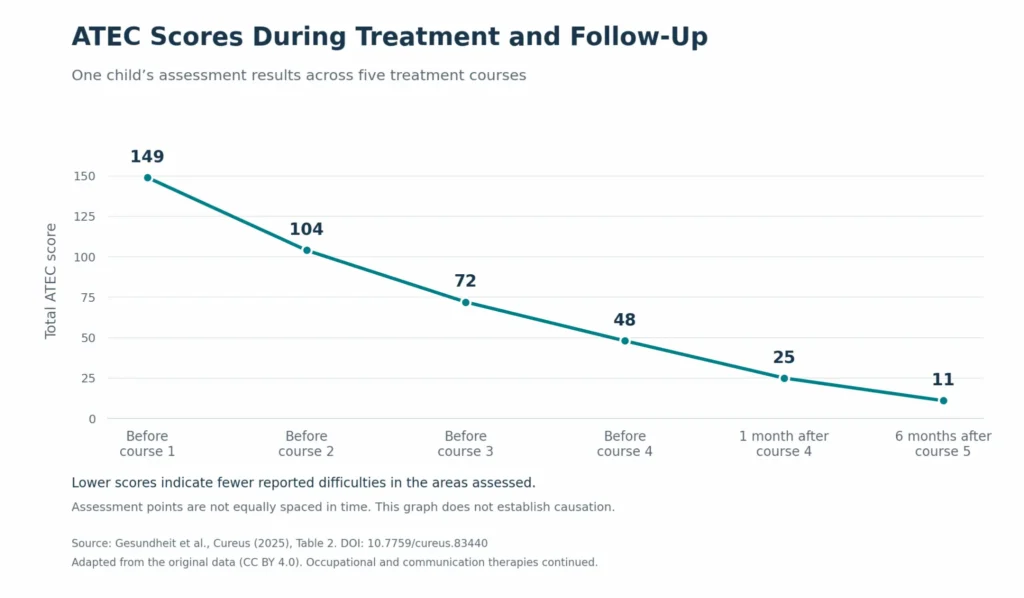
- The Autism Treatment Evaluation Checklist (ATEC) is a 77-item questionnaire usually completed by a parent or caregiver. It covers speech and communication, sociability, sensory and cognitive awareness, and health and behaviour. Repeated assessments help track changes over time, with lower scores indicating fewer reported difficulties. It is a monitoring tool rather than a diagnostic test.
- The Social Responsiveness Scale–2 (SRS-2) is a 65-item questionnaire that parents or teachers complete based on a child’s everyday behavior. It assesses areas such as noticing social cues, communicating with others, engaging socially, and repetitive behavior. Repeated scores can help track changes over time, with lower scores indicating fewer reported difficulties.
- Observations from parents and teachers, describing play, learning, communication, and independence.
The published assessment points extend from before the first course to six months after the fifth.
Changes Documented During Follow-Up
The publication follows changes in the boy’s health, communication, and everyday skills across five treatment courses. Alongside clinical findings, it describes moments that mattered to his family: joining games, expressing discomfort, and becoming more independent.
Seizures and EEG Findings
The authors report that no further seizures were observed after the first course. An EEG assessment 18 weeks later was described as normal.
Antiseizure medicines were gradually discontinued later in the treatment journey. In his interview, Dolev’s father explains that this process was guided by their neurologist following repeat EEG assessments.
After the first course, the report describes longer sentences, clearer pronunciation, and more attempts to start conversations. Dolev also began showing greater interest in other people and playing with his siblings.
Later observations included expressing feelings and physical discomfort, greeting people, and inventing games. Following the fourth course, parents and teachers described further gains in conversations, friendships, and understanding other people’s needs.
Everyday Skills and Independence
Changes were also noticed in practical activities. After the second course, the boy was described as walking for longer without tiring, swinging independently, and beginning to hold a pencil and draw.
Later, he became more independent with showering and homework. Teachers reported improvements in attention, reading, and writing, while his family noticed that he could follow more complex instructions with fewer reminders.
Changes in Assessment Scores
The observations were accompanied by lower scores on both assessment tools used in the report.
The total Autism Treatment Evaluation Checklist (ATEC) score decreased from 149 before the first course to 11 six months after the fifth course. Lower ATEC scores indicate fewer or less severe difficulties in the areas assessed.
The total SRS-2 score decreased from 193 before the first course to 32 six months after the fifth course, with lower scores across all five areas assessed:
| Area assessed | Before the first course | Six months after the fifth course |
| Social awareness | 23 | 0 |
| Social cognition | 36 | 4 |
| Social communication | 65 | 15 |
| Social motivation | 30 | 7 |
| Restricted interests and repetitive behaviour | 39 | 6 |
| Total score | 193 | 32 |
These scores describe changes in this child’s assessments; they should not be interpreted as a percentage of recovery or evidence that autism was cured.
Tolerability During Treatment
The report describes a brief episode of fever and shivering during the third course, which resolved after paracetamol. The authors state that the MSC dose was reduced for the following course in response to this experience.
The Family’s Later Updates
The family continued sharing their experience beyond the five treatment courses described in Cureus. These later interviews offer a personal view of their son’s everyday life and subsequent visits to Swiss Medica.
The observations below extend beyond the published case report and are not included in its assessment results.
His Father Reflects on a Sixth Visit
In this interview, his father shares memories of the family’s first visit in March 2019 and what brought them back to Swiss Medica.
He talks about the changes they noticed in daily life: his son using words to express what he wanted, starting conversations, and becoming more independent.

In this later interview, his mother shares how her son is doing in everyday life—from having short conversations and reading and writing to managing more of his daily routine on his own, such as showering and using the toilet.

What This Case Can Tell Us
For this family, the changes described involved meaningful parts of daily life: expressing a need, joining a game, or completing a task more independently. The publication brings those observations together with EEG findings and repeated assessment scores.
As a case report, it documents one child’s experience in detail. It can help identify questions for further research, but it cannot establish that MSC treatment caused the changes or predict how another child will respond.
We share the publication and the family’s interviews to make this individual experience easier to explore, while keeping the documented findings and personal observations in context.
Get a free online consultation
If you have any questions or would like to learn more about potential treatment options, please fill out the form below to arrange a no-obligation online consultation with our team.

Medical Advisor, Swiss Medica doctor